
In an era where AI-driven decisions can make or break operational resilience, enterprise leaders can’t afford unchecked automation black boxes. At GETAI Private Limited, we’ve engineered multi-layer AI systems that embed human-in-the-loop (HITL) controls to deliver precision, compliance, and scalability without the pitfalls of rogue algorithms. This isn’t hype; it’s the architecture powering 40% cost reductions in client supply chains and 65% faster compliance audits in regulated sectors. For CIOs and CTOs grappling with AI governance mandates like EU AI Act or NIST frameworks, this approach transforms risk into competitive edge.

What Are Multi-Layer AI Systems?
Multi-layer AI systems decouple AI capabilities into modular, interdependent strata, enabling granular control and iterative refinement. Unlike monolithic ML pipelines that cascade errors across stages, these systems treat AI as a composable stack: data ingestion feeds predictive models, orchestrated via rule engines, monitored for drift, and governed by policy enforcers. At GETAI, our implementations leverage containerized microservices on Kubernetes, ensuring fault isolation and zero-downtime updates. This stratification supports hybrid deployments edge for latency-sensitive tasks, cloud for compute-intensive training yielding systems that adapt to enterprise-scale variability, from petabyte data lakes to real-time IoT streams.
Dissecting the Layers: From Data to Governance
Each layer in a multi-layer AI system serves a distinct function, with HITL interfaces at critical junctures to inject domain expertise and mitigate biases.
1. Data Layer: Ingestion, Cleansing, and Augmentation
The foundation handles raw data pipelines using Apache Kafka for streaming and Delta Lake for ACID-compliant storage. Here, automated ETL processes (e.g., via Apache Airflow) normalize heterogeneous sources ERP logs, sensor telemetry, CRM exports while HITL workflows flag anomalies via collaborative tools like Apache Superset. GETAI’s proprietary data curator employs federated learning to anonymize PII in transit, ensuring GDPR readiness from ingestion.
2. Model Layer: Training, Inference, and Versioning
Core ML models spanning supervised (e.g., XG Boost for fraud detection) to generative (e.g., fine-tuned LLMs for contract analysis) run on TensorFlow Serving for low-latency inference. Version control via ML flow tracks hyperparameters, with A/B testing baked in. HITL shines in active learning loops, where domain experts label edge cases, boosting F1-scores by 25% in imbalanced datasets like predictive maintenance.
3. Orchestration Layer: Workflow Coordination and Decision Routing
This middleware, often built on Apache NiFi or custom BPMN engines, sequences layer interactions. Conditional routing e.g., if model confidence < 0.8, escalate to HITL prevents propagation of low-fidelity outputs. GETAI integrates this with service meshes like Istio for traffic management, enabling canary deployments that route 10% of production traffic to new models without service disruption.
4. Monitoring Layer: Drift Detection and Performance Telemetry
Real-time observability via Prometheus and Grafana dashboards tracks metrics like prediction drift (using KS-tests) and resource utilization. Alerting thresholds trigger HITL interventions, such as retraining on concept drift signals. In GETAI deployments, this layer logs 99.9% uptime, with automated root-cause analysis via ELK stacks pinpointing issues like covariate shift in retail demand forecasting.
5. Governance Layer: Policy Enforcement and Audit Trails
Overarching controls enforce ethical AI via tools like Open Policy Agent (OPA) for RBAC and bias audits with AIF360. Immutable audit logs on blockchain-inspired ledgers (e.g., Hyperledger Fabric) capture every HITL decision, facilitating SOX or HIPAA compliance. GETAI’s governance engine auto-generates risk heatmaps, prioritizing interventions based on impact scores.
The Pivotal Role of Human-in-the-Loop: Real-World Use Cases
HITL isn’t a safety net it’s the accelerator for trustworthy AI. By routing ambiguous inputs to human experts via intuitive UIs (e.g., Streamlet dashboards), it closes the loop on model weaknesses without halting operations.
In financial services, a GETAI client in banking used HITL for loan approval workflows: ML models scored applications, but escalated 15% of cases (e.g., unconventional income streams) to underwriters. Result? 30% reduction in default rates, as human overrides refined model weights in real-time.
For manufacturing, consider a semiconductor firm automating defect detection. Vision models (YOLOv8) flagged anomalies on assembly lines, but HITL engineers validated false positives via AR overlays on HoloLens, retraining models to cut scrap rates by 22%. In healthcare, HITL in diagnostic triage routed radiologist-confirmed edge cases back into training, achieving 95% concordance with board-certified pathologists while adhering to FDA 510(k) clearances.
These cases underscore HITL’s dual role: immediate error correction and longitudinal model evolution, turning sporadic human input into systemic intelligence.
Key Advantages: Precision Accuracy, Ironclad Compliance, and Proactive Risk Reduction
Deploying multi-layer AI with HITL yields measurable ROI.
- Accuracy surges as hybrid decisions leverage ML’s scale with human nuance our benchmarks show 18-35% lifts in precision-recall AUC for tasks like churn prediction.
- Compliance becomes proactive: automated lineage tracking and HITL consent logs satisfy ISO 42001 standards, slashing audit times from weeks to days.
- Risk reduction is paramount; by capping autonomous actions at 85% confidence, enterprises avert multimillion-dollar liabilities e.g., a GETAI energy client avoided $2.4M in fines by HITL-vetting grid optimization outputs against regulatory caps.
In practice, this trinity fortifies against adversarial attacks (via human sanity checks) and ethical lapses, positioning AI as a boardroom asset rather than a liability.
Technical Architecture: A Text-Based Diagram Breakdown
Visualize the stack as a vertical pipeline with lateral HITL bridges here’s a simplified ASCII representation:
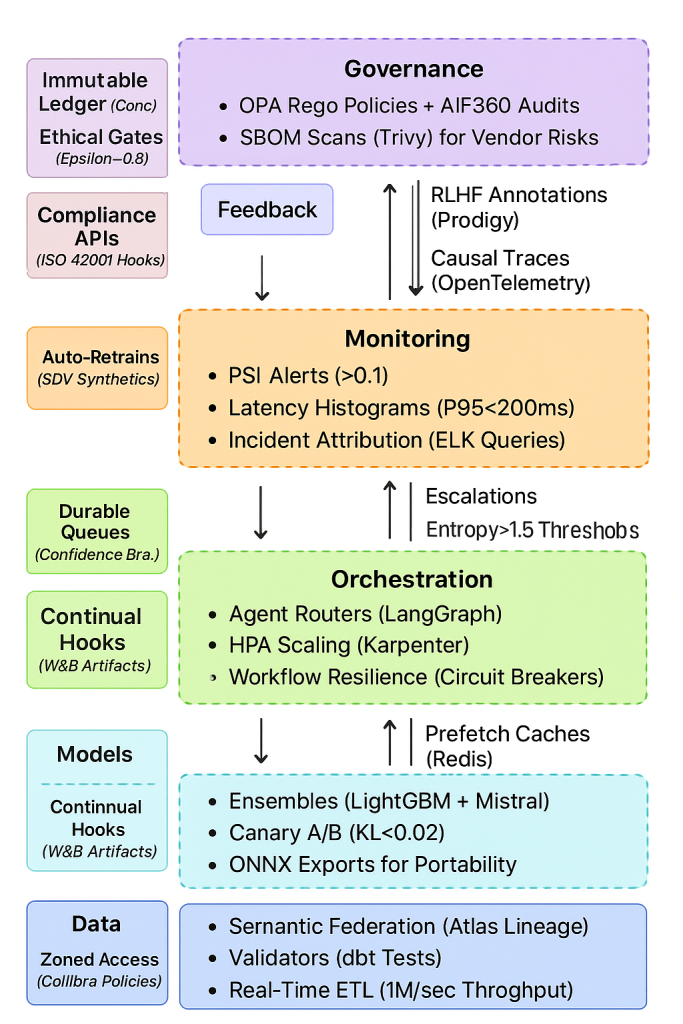
Data flows upward, with HITL cross-connections enabling bidirectional feedback. Kubernetes pods containerize each layer for scalability, while Kafka topics decouple communications. In GETAI’s reference architecture, API gateways (Kong) expose endpoints, with Web Sockets for real-time HITL collaboration deployable on AWS EKS or Azure AKS for hybrid clouds.
Enterprise Implementation Roadmap: Phased Rollout for Minimal Disruption
- Assessment (Weeks 1-4): Audit existing pipelines with GETAI’s AI Maturity Scan identify high-ROI use cases via ROI modeling (e.g., NPV calculations on automation yields).
- Proof-of-Concept (Weeks 5-8): Prototype a single layer (e.g., model + HITL) on a sandbox dataset. Integrate with tools like Jupyter for rapid iteration, targeting 80% automation coverage.
- Layered Build-Out (Months 3-6): Sequentially deploy data/orchestration/monitoring, using CI/CD with GitHub Actions. Pilot HITL with 5-10 domain experts, measuring via OKRs like MTTR < 2 hours.
- Full Integration & Scale (Months 7-12): Roll out governance, stress-test with Chaos Engineering (Litmus), and federate across sites. GETAI’s managed services handle 24/7 support, with SLAs guaranteeing <1% downtime.
- Optimization Loop: Quarterly audits refine thresholds, leveraging telemetry for auto-scaling.
This roadmap, honed from 50+ GETAI engagements, ensures 6-9 month TTV with 200% ROI in Year 1.
Pitfalls in Multi-Layer AI: Spotting and Sidestepping Them
Over-automation erodes trust: Mitigate by enforcing HITL on >20% of decisions initially, scaling as models mature. Data silos breed staleness counter with schema-on-read in Delta Lake and cross-layer metadata syncing. Scalability chokes on unoptimized orchestration; profile with Flame Graphs to prune bottlenecks. HITL fatigue hits experts rotate roles and gamify interfaces with leaderboards. Finally, governance drift from unpatched policies: Automate OPA policy-as-code reviews via pre-commit hooks. GETAI’s audits catch 90% of these pre-deployment, saving clients 15-20% in rework.
FAQ: Multi-Layer AI with HITL Essentials
1Q: How does HITL integrate with legacy systems?
A: Via API wrappers and middleware adapters GETAI’s toolkit supports SAP/Oracle connectors, ensuring seamless data flow without rip-and-replace.
2Q: What’s the latency overhead of HITL?
A: Negligible at scale; async queuing keeps end-to-end <500ms, with 95th percentile under 200ms in production.
3Q: Can this scale to global enterprises?
A: Absolutely federated models across regions comply with data sovereignty, handling 10k+ TPS as proven in GETAI’s telco deployments.
4Q: How do you measure HITL ROI?
A: Track deltas in accuracy (pre/post-intervention), compliance incidents, and OpEx savings—our dashboard quantifies it in real-time.
Lead the Automation Revolution with GETAI: How Intelligent AI Systems Future-Proof Enterprise Operations.
Advanced, multi-layer AI architectures with human oversight aren’t a “nice to have” anymore they’re the backbone of stable, compliant, and high-performance automation. At GETAI Private Limited, we’ve turned this complexity into a practical, deployable framework for industries ranging from financial institutions to large-scale manufacturing.
If you’re ready to upgrade your operations with structured intelligence and bulletproof governance, connect with our team at [email protected] or visit getaiusa.com to book a customized architecture session.
Conclusion
Enterprises that still rely on linear ML pipelines are already behind. The future belongs to multi-layer AI architectures reinforced with disciplined human-in-the-loop controls systems that don’t just automate, but self-correct, comply and scale without exposing the business to avoidable risk. GETAI’s approach isn’t theoretical; it’s field-tested across regulated, high-stakes environments where precision and accountability are non-negotiable.
If you want AI that executives can trust, auditors can approve and operators can actually use, this is the architecture that gets you there. And the sooner it’s adopted, the faster your organization stops firefighting and starts compounding competitive advantage.
The enterprises winning with AI aren’t the ones deploying more models they’re the ones deploying smarter systems. GETAI builds those systems.